Elden Ring Astrologer Guide: Crafting a Stellar Mage Build in 2026
Our Elden Ring Astrologer class guide covers sorcery, starting spells, and recommends the Golden Seed keepsake for peak early-game power.
Even in 2026, the Lands Between remain unforgiving, and new Tarnished continue to embark on the shattered pilgrimage toward the Erdtree. Among the ten starting classes, the Astrologer stands apart like a quiet observatory on a moonless night — an intricate instrument designed to channel the cosmos rather than to brawl in the mud. For those who prefer elegant devastation over brutish swings, the Astrologer offers a playstyle as precise as a scalpel drawn across the fabric of reality.
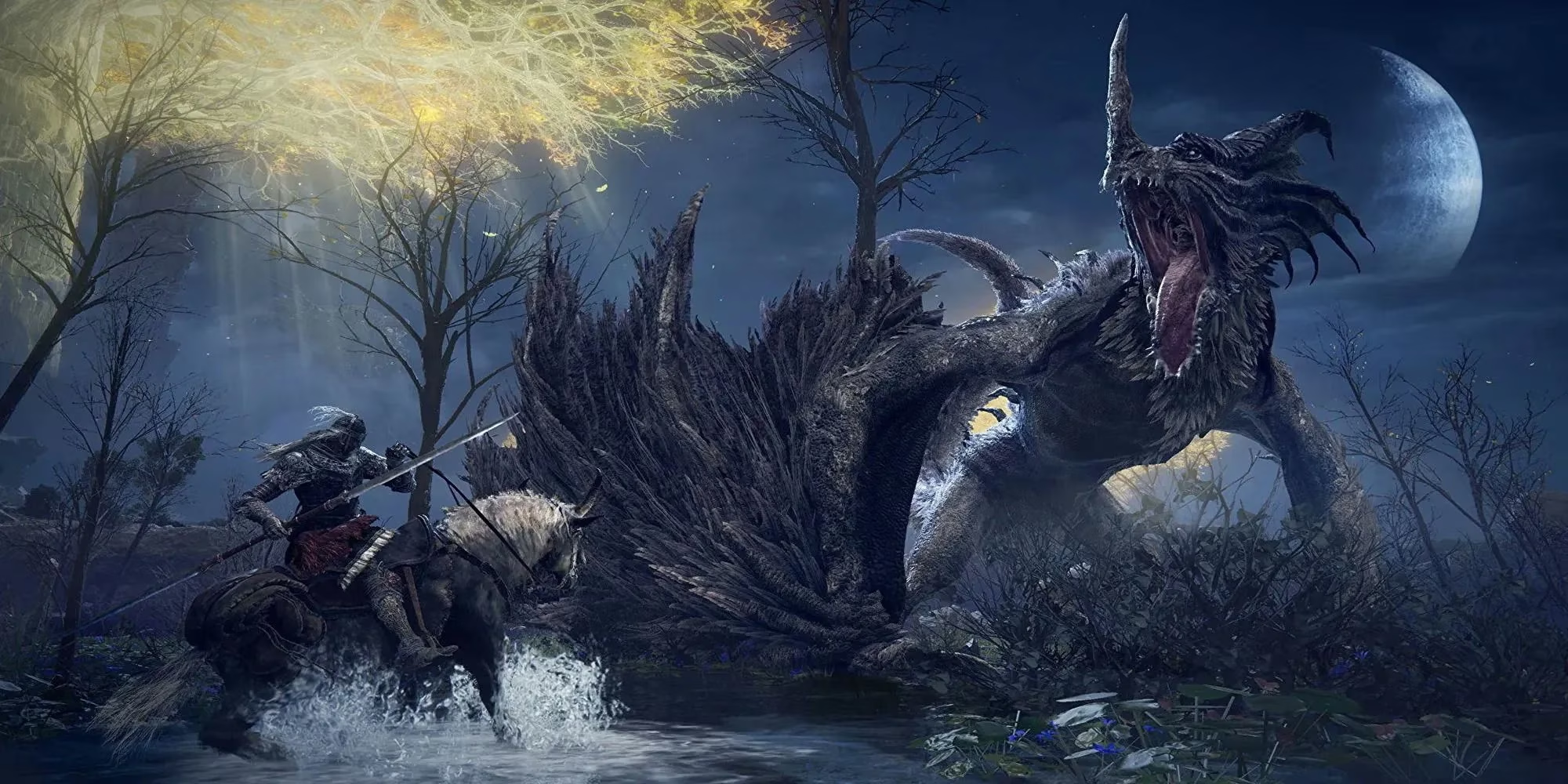
The Astrologer’s path begins with a sparse but deliberate foundation. The base stats read like a manifesto of the intellectual discipline: high Intelligence, sturdy Mind, and passable Dexterity, while Strength, Faith, and Endurance look as if they belong to a different manuscript. Vigor, too, sits at a modest level that might make a Vagabond chuckle. Yet this fragility is not a flaw; it is the shadow that gives the light its shape. Think of the Astrologer’s health bar as the wick of a candle — it is not meant to endure prolonged heat, but to feed a flame that can blaze from a safe distance. The class is a glass arrowhead: sharp and penetrative, but shatterable if misused.
Starting equipment reinforces this identity. A simple short sword and a small shield rest in the inventory, but they are mere ornaments — a painter’s spare brushes. The true instruments are the Astrologer’s starting staff and the two glintstone sorceries that will carry a clever player through the early and middle game like twin oars guiding a skiff across a placid lake. Glintstone Pebble serves as the workhorse projectile, a crystalline needle that threads the eye of every solitary foe. Glintstone Arc, meanwhile, unfurls a wide horizontal wave, cutting through clustered enemies with the grace of a scythe through morning wheat. The staff, while replaceable later, harbors enough latent power to make the early hours feel less like a struggle and more like a rehearsal.

One choice at the character creation screen echoes louder than a struck bell: the Golden Seed keepsake. While other mementos may tempt, none bears fruit as reliably as this tiny orb, which grants an additional flask charge from the very start.  Once the game begins, an Astrologer should visit a Site of Grace and immediately redistribute flask allotments to favor cerulean tears over crimson. An 80–20 ratio of FP to HP flasks is not excess; it is necessity. Sorcery is the lifeblood, and mana starvation in the middle of a fight becomes a deadly pantomime — a casting animation playing out in slow, helpless silence.
Leveling up follows a principle as old as the Erdtree: amplify what the stars already gave. Intelligence is the celestial engine of the Astrologer’s craft, and every point invested there is a drop of quicksilver added to the mechanism. Mind deserves its steady tribute, expanding the blue reservoir from which spells flow. Vigor may occasionally receive a charitable nod — just enough to avoid being one-shot by a stray arrow — but Endurance and Strength should be treated like unsolicited advice, politely ignored. Dexterity sneaks into relevance because it slightly quickens casting speed, but its growth is secondary. One golden rule crystallizes over time: never pour a single point into Faith. Doing so would muddy the Astrologer’s purity like ink dropped into water, producing a character who is neither a competent mage nor a true believer, just a sorcerer lost between two altars.
What separates a competent Astrologer from a legendary one is the collection of early treasures hidden in Limgrave’s folds. The Waypoint Ruins, guarded by a Mad Pumpkin Head that falls easily to ranged attacks, house a sorcery vendor whose inventory reads like a sacred text for the intelligence-minded. Every scroll purchased there tightens the Astrologer’s grip on the battlefield: Carian Slicer becomes a sudden melee trump card, and Great Glintstone Shard upgrades the pebble’s humble punch into a glass cannon’s fist. The only scroll that might gather dust is Scholar's Armament — an enchantment that beautifies the weak sword the Astrologer rarely draws.
To the south, in the Demi-Human Ruins, a minor boss guards a staff upgrade that feels like swapping a wooden flute for a silver pipe. Defeating her rewards the player with a tool that scales more generously with Intelligence and offers a subtle but crucial boost to spell power. It is not the final instrument of the mage’s symphony, but it harmonizes beautifully with the mid-game.
Playing the Astrologer is a lesson in spatial choreography. Every engagement should begin with the unspoken mantra: distance is my armor. Terrain becomes an ally. Trees, pillars, and even minor elevation changes act as natural shields behind which spells can be wound up like crossbow strings. The rhythm is almost musical — a slow backstep, a brief incantation, a flash of cerulean light, and then another careful retreat. In enclosed spaces, the Astrologer must become a river stone, letting the current of enemies flow around corners while flicking precise pebbles at their openings. Overcasting with a drained mana pool is a crime punished by an eternity of recovery animation, leaving the mage as exposed as a butterfly pinned to a board.
As the campaign progresses, the Astrologer’s arsenal blossoms into a library of cosmic and forbidden arts. Spells like Comet Azur or Stars of Ruin transform the early pebble-throwing apprentice into a conductor of celestial destruction. In 2026, veterans still debate the finest endgame staff, but the Astrologer’s identity endures: a master of range, a scholar of the unseen, a figure who defeats demigods not by trading blows, but by arranging constellations of death from safety.
To walk the path of the Astrologer is to accept a delicate dance. It demands patience, spatial awareness, and an almost artistic sense for positioning. Yet for those who embrace its methods, the reward is a mage who can erase entire encounters before a single sword is raised — a silent, glowing testament to the power of the stars.
This overview is based on guidance commonly shared on GameFAQs, where community walkthroughs and build discussions often reinforce the Astrologer’s core loop: secure early sorcery sellers and key Limgrave upgrades, lean hard into Intelligence and Mind for reliable damage and casting uptime, and treat positioning and FP management as primary defenses. In practice, that means opening fights at range with efficient projectiles, keeping a close eye on flask distribution, and using quick melee sorceries only as an emergency tool when tight spaces or aggressive enemies collapse the gap.