Elden Ring Nightreign: A Roguelite Soulslike That Somehow Works
Elden Ring Nightreign blends Soulslike and roguelite mechanics, offering fresh randomisation and seamless co-op for thrilling gameplay.
FromSoftware has a habit of saying one thing and doing another. Hidetaka Miyazaki swore up and down that Elden Ring was done: no more DLC, no sequel, go home, nothing to see here. Then TGA 2024 rolled around, and a trailer dropped showing what looked like Limgrave, characters moving like Sekiro's Wolf, and a whole new adventure. The collective gaming world was on tenterhooks. Then came the twist: it was a roguelite. A roguelite! FromSoftware, the studio that takes five years to decide on a font, was going to crank out a mechanically rich roguelite in a year while also introducing seamless co-op? That sounded as believable as Patches promising a mountain of treasure down a hole. Just lean over and take a peek. He definitely won't kick you. (He will.)
Many players braced for a hastily thrown-together asset flip, a stopgap before the next 'real' project. But after five hours of hands-on time, even the most skeptical soul had to eat their words. Nightreign is not a trainwreck. It is a meticulously crafted mashup that shouldn't work, yet absolutely does.

Randomisation Keeps Nightreign Fresh
Soulslike games have always been about customisation. Players can be glass cannons flinging whirlwinds of magic, or they can clobber bosses with a big stick. Nightreign takes that philosophy and cranks it to eleven. Classes are replaced by eight Nightfarers, each with unique ultimate abilities and starting gear. Levelling is streamlined: every stat goes up at once, so there is no fine-tuning. On paper, that sounds like less freedom. In practice, it is a chaotic buffet of opportunity.
Because every run is random, players are forced to use whatever drops. Builds they would never dream of trying naturally emerge. One previewer had over 600 hours in Elden Ring across two platforms but had never touched the Envoy's Long Horn. In Nightreign, it was the highest-level weapon they found, so they had to learn its moveset on the fly. Another run was powered entirely by a bow and arrow, which inspired a whole new archer build back in the base game. This is why randomised Twitch streams are so popular: the Soulsborne series has more depth than most people ever see.

By removing stat requirements altogether, every single weapon matters. Roguelites thrive on synergy, and Elden Ring was already built on that same synergy. Director Junya Ishizaki and his team found a way to make the randomness feel organic. One of their chief inspirations? Battle royales. Yes, really.
The Battle Royale Inspirations Are Surprisingly Welcome
Souls games usually work by interspersing checkpoints and bosses throughout an area, letting players learn them inside and out through rigorous trial and error. Throwing that out for randomised runs risked upending the entire formula. The Ring of Fire, which works like Fortnite's storm, prevents that from happening. Mastering an area is impossible because it changes every time. But each match becomes a rapid-fire microcosm of the usual Elden Ring experience.
Bosses and enemies might be random, but every match feels like stepping out of the Stranded Graveyard into Limgrave for the first time. As veterans learned in Elden Ring, charging at the Tree Sentinel is a bad idea. So is making a beeline for Margit and Stormveil Castle. Nightreign encourages a similar rhythm. Instead of fighting the hardest bosses for the most Runes, it is wiser to take it slow, find upgrades to the healing flask at nearby churches, and pick off manageable minibosses.
It is like reliving those opening hours on a loop, but fresh every time. Relearning the map over and over takes some getting used to, yet the intimate familiarity players build with FromSoftware's world design is as rewarding as any handcrafted runback. Even if the structure is radically different, the soul is intact.

FromSoftware Has Perfected Soulslike Co-Op
Concerns about a rush job, or the roguelite and battle royale elements not fitting, were just the tip of the iceberg. The biggest worry was seamless co-op. How would it work in a soulslike? FromSoftware knocked it out of the park on the first try.
In other Soulsborne games, dying as a host means summons get sent home. In Nightreign, there is a more traditional revive system, but with a classic FromSoftware spin: players have to attack their fallen teammates to get them back up. It is an incredibly intuitive system that fits the soulslike formula. The more someone dies, the harder they are to revive, which means dying during the final boss of each day is still punishing. Players must balance dodging attacks while landing hits on allies, which can take a while if they have gone down a few times. That forces a split-second judgment call during an already high-octane fight: is it worth the risk, and frankly, will those teammates be much help anyway?
If a player dies in the open world, a timer is thrown on top. But in perhaps the most forgiving mechanic in a Soulsborne game, if the timer runs out before a revive, they simply respawn one level weaker. FromSoftware has taken a classic co-op mechanic and made it feel at home. There is still an edge to how co-op works, but it is not obtuse or archaic. Explaining summon signs, level ranges, and equipment restrictions to newcomers was always an uphill battle. Nightreign integrates seamless co-op without sacrificing what makes soulslikes unique.
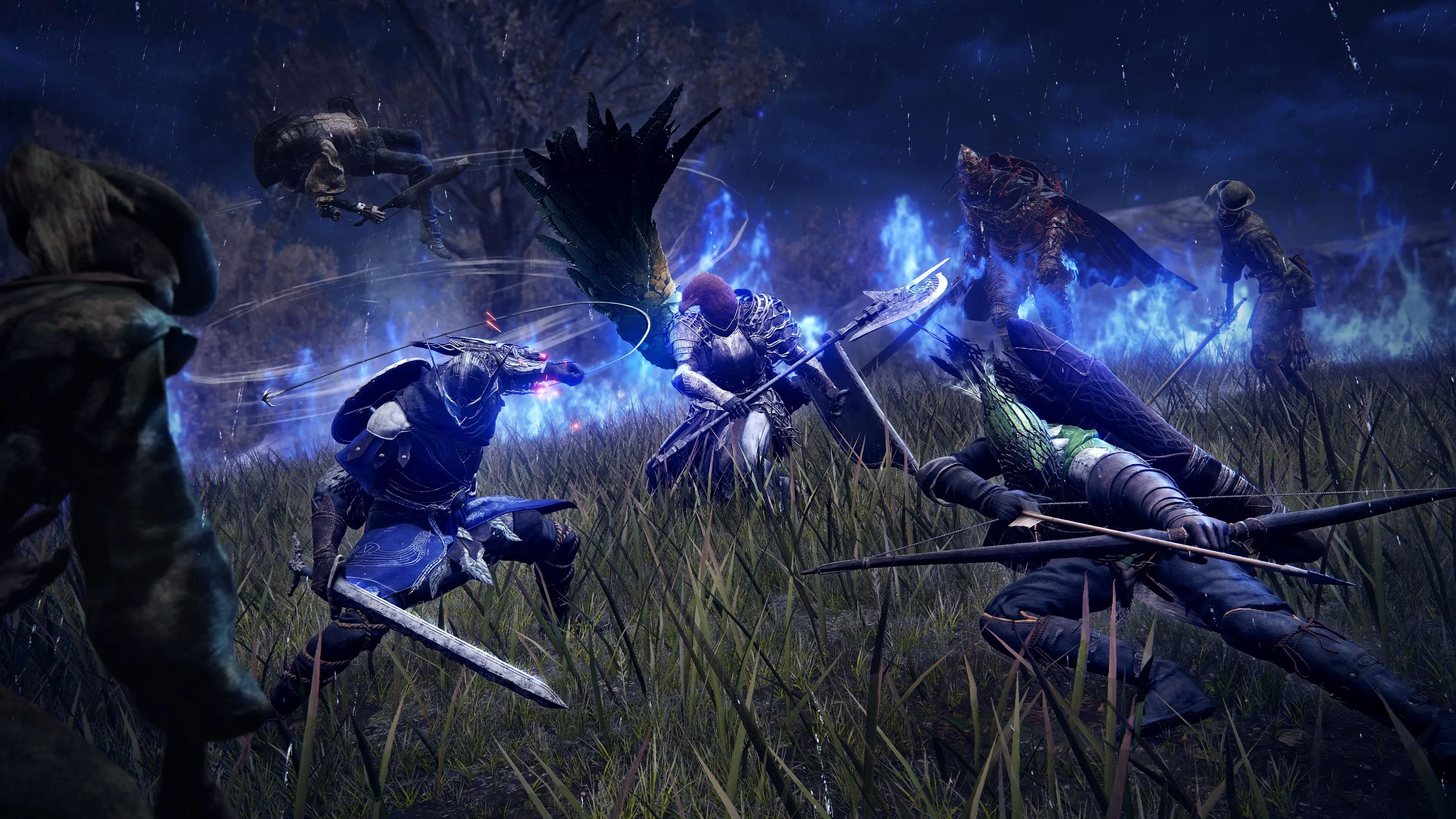
A Mishmash That Should Be a Trainwreck
Just five hours with Elden Ring Nightreign, against only one of its eight Night Lords, was enough to put worried minds at ease. The game is as in-depth and satisfying to master as any other soulslike, while standing out from every other FromSoftware title. It feels one part roguelite, one part soulslike, one part battle royale, and another part extraction shooter. It is a mishmash of trends, using the bones of another game, launching a year after a hugely expansive DLC for its predecessor. It should be a complete trainwreck. Yet everything flows together meticulously.
In 2026, with the benefit of hindsight, Nightreign remains a rewarding experience that condenses the soulslike loop into a short but incredibly satisfying burst. For anyone still on the fence, the message is simple: stop clutching your Runes and give it a go. The Night Lords are waiting. Just don't trust Patches.