How Little of the Lands Between I Actually Needed to Explore in Elden Ring
Elden Ring's required path is short—only two demigods needed to enter Leyndell—while optional areas like Caelid and the underground can be skipped.
I still remember my first hours in Limgrave. The golden Erdtree loomed on the horizon, and every cliff, cave, and ruin seemed to whisper that I should investigate. Like many Tarnished, I assumed this massive open world was an entire checklist to complete before the credits could roll. But after several playthroughs and more than a few community maps, I learned something that still feels almost heretical: Elden Ring only actually requires you to touch a tiny fraction of the Lands Between.
🗺️ 
When I began my journey, I spent days wandering through Limgrave's forests, fighting trolls, clearing catacombs, and losing runes to Tree Sentinels. I pushed into the Weeping Peninsula, roamed the misty woods, and eventually stormed Stormveil Castle to face Godrick the Grafted. From there, I crossed into Liurnia of the Lakes, where Raya Lucaria Academy waited with Rennala at its center. At the time, I believed both demigods were absolute necessities, and in a loose sense they were convenient milestones. But I eventually discovered that the game's critical path is far more forgiving than the size of the map suggests.
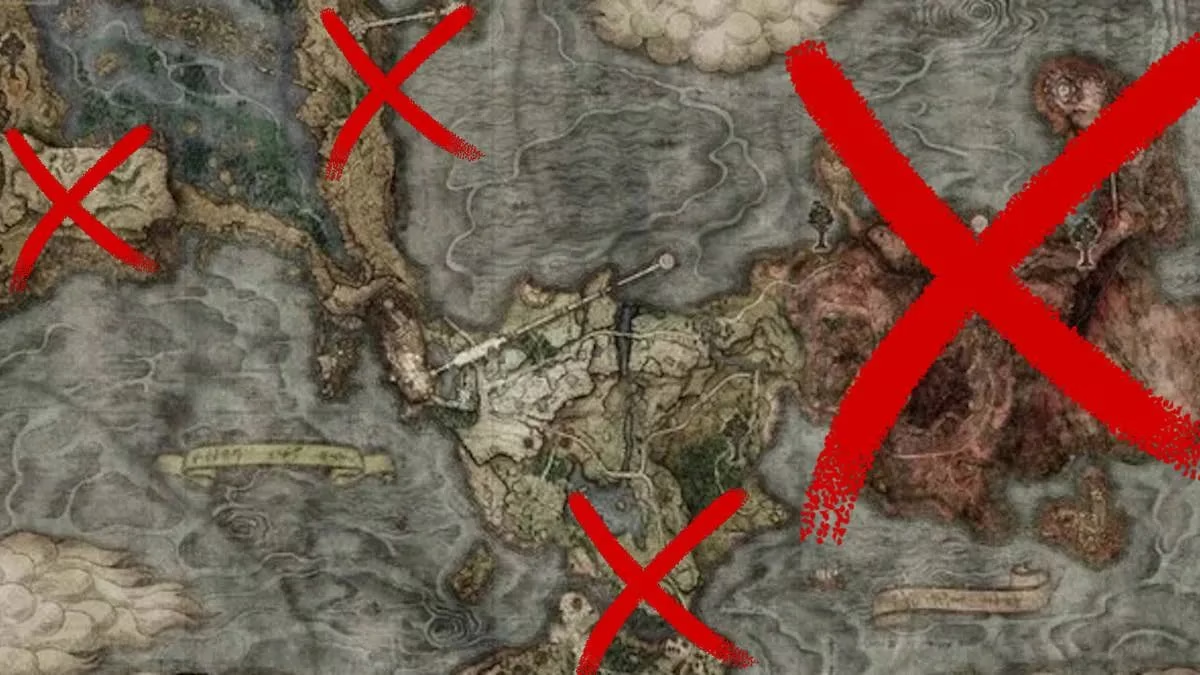
A minimalist map shared by the community illustrates it perfectly: entering Leyndell, the Royal Capital, only demands the defeat of two demigods. Godrick and Rennala simply happen to be the most convenient choices because they lie on the route north from Limgrave through Liurnia. Players can ignore them entirely and hunt other shardbearers instead, such as exploring Caelid or descending into the underground rivers of Siofra and Ainsel. The map reveals that most of Limgrave, Liurnia, Altus Plateau, and even the Mountaintops of the Giants is completely optional. You never need to set foot in Caelid or the vast underground ecosystems to see the ending.
After the capital, the path narrows significantly. Once inside Leyndell, the game becomes much more linear. You ascend the Mountaintops of the Giants, get swept into Crumbling Farum Azula, and then return to a transformed capital to face the final battles. This means the actual mandatory footprint is a slim ribbon cut through an enormous world. I remember staring at that realization and feeling a strange mix of relief and sadness. Relief because a speedrun or a focused character build could avoid entire regions; sadness because FromSoftware had hidden catacombs, legacy dungeons, NPC questlines, and environmental storytelling in all those optional corners.
The map itself is more of a quiet companion than a taskmaster. In most open-world games, icons and objective markers constantly drag you toward the next question mark. In Elden Ring, the map offers waypoints and beacons, but it never demands that you follow a dotted line to a glowing mission giver. My own route was driven by curiosity. I placed a marker once on a cliffside I wanted to revisit, and another time on a lake shore that looked suspiciously like a boss arena. The map helped me remember, but it did not dictate my adventure. That philosophy is rare, and it is one of the reasons the game's scale never feels like busywork.
To make the contrast clearer, here is a simple breakdown of required versus optional territory based on my playthroughs:
| Category | Examples | Required? |
|---|---|---|
| Early game critical path | Stormveil Castle, Raya Lucaria Academy if chosen | Yes, two demigods |
| Southern Limgrave and Weeping Peninsula | Castle Morne, tombs, merchant routes | No |
| Caelid | Radahn's festival, swamps, Sellia | No |
| Underground rivers | Siofra, Ainsel, Nokron, Nokstella | No |
| Altus Plateau outskirts | Shaded Castle, Windmill Village | Mostly no |
| Post-Leyndell path | Mountaintops, Farum Azula, capital return | Yes |
This table is not a criticism. I love that these areas exist and would never recommend skipping them on a first run. But understanding how small the true critical path is changed how I approach new characters. Sometimes I want the full open-world pilgrimage; other times I want to rush a build, collect two Great Runes, and test myself against the late-game gauntlet. The game quietly supports both styles, and that flexibility is one of its greatest strengths.
Even in 2026, after many replays and the wider evolution of FromSoftware's catalogue, Elden Ring remains a masterclass in optional exploration. The Lands Between are enormous, but the golden path toward Elden Lord is much narrower than most people realize. Still, if you ask me, taking that narrow path alone would be a huge disservice. The real story of Elden Ring lives in the optional places: a hidden chapel, a crumbling mine, a lonely evergaol, or a sudden view of the Erdtree from a cliff you were never told to climb.
That is why I keep returning. Not because the game demands it, but because the Lands Between are too beautiful to leave unexplored.