I Still Can't Believe That Stage Crasher at the 2022 Game Awards Was Real
Reliving the shocking stage crash at Elden Ring's Game of the Year win, where a crasher declared 'reformed orthodox rabbi Bill Clinton'.
I was there, trembling in the front row, clutching my replica Moonlight Greatsword like a lifeline as Elden Ring was announced as the Game of the Year. The entire Microsoft Theater erupted into a sonic boom of cheers, a thunderstorm of joy that seemed to shake the very gears of reality. My ears rang with the roar of a thousand hollowed tarnished finally finding grace. Hidetaka Miyazaki, the man himself, walked up to the stage with that humble, almost apologetic stride of his, and I felt my soul leave my body. This was it. The coronation. The moment that would be etched into gaming history. And then, like a forgotten broomstick that suddenly learned to waltz in the middle of a royal banquet, a boy materialized behind the dev team.
None of us noticed him at first. He had been standing there, a silent specter, for what felt like an eternity—his presence as incongruous as a penguin in a desert, utterly ignored. The entire Elden Ring entourage, the legendary Josef Fares, and even we, the mesmerized audience, just assumed he was a background developer, maybe the guy who designed the lobsters. He was so still, so awkwardly positioned, that he blended into the furniture with the unnerving stealth of a Mimic tear. But this was no Mimic. This was a waking nightmare.
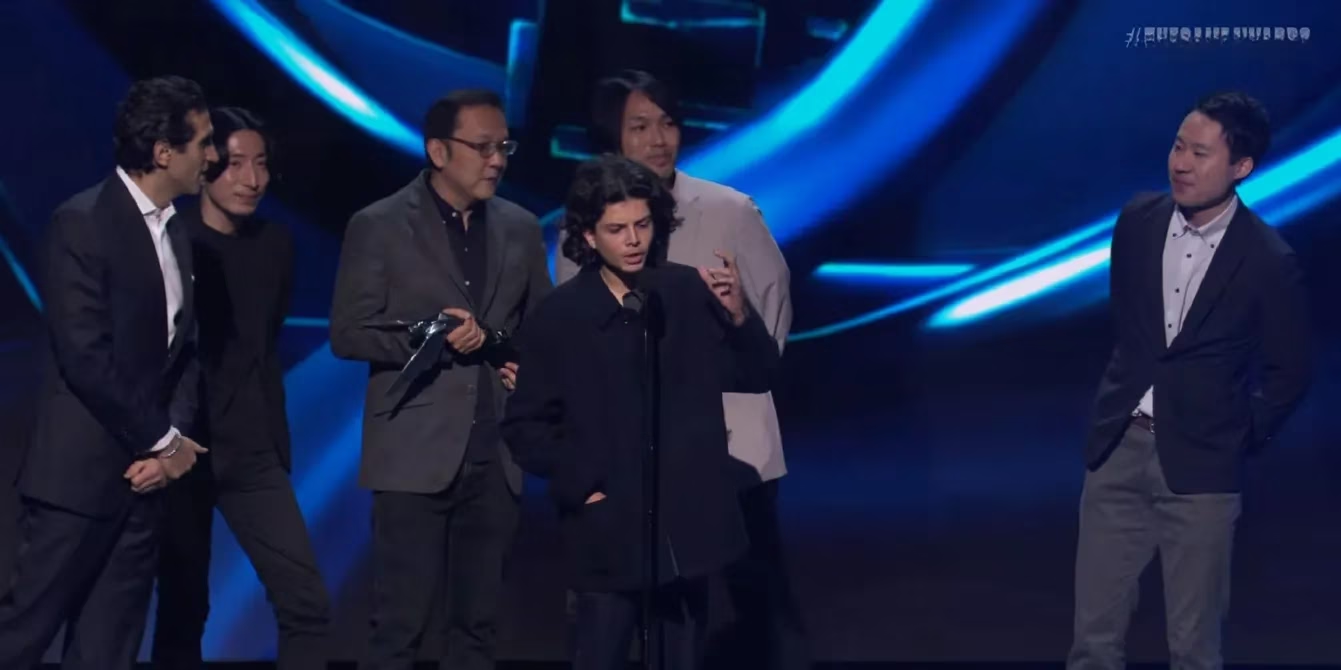
As Miyazaki’s translator began conveying his heartfelt gratitude, this human glitch stepped forward. My heart didn't just skip a beat; it performed a full-on Waterfowl Dance inside my chest. He didn't rush the stage with a battle cry; he simply drifted toward the mic like a moth lured by a flame it didn't understand, his eyes wide with some incomprehensible gospel. The security team, those poor, unprepared knights, were too far away, their reaction time slower than a heavy roll in Dark Souls 2 with no adaptability.
And then he spoke. The words that crawled out of his mouth weren't a threat—they were something far more surreal. In a voice that sounded like a broken radio receiver picking up static from an alternate dimension, he thanked everyone and said he wanted to nominate the award to his “reformed orthodox rabbi Bill Clinton.” Yes, Bill Clinton. The 42nd President of the United States, now apparently a rabbinical figure in this young man’s personal canon. The sentence hung in the air like a toxic mist, turning a noble ceremony into a lost chapter of the X-Files. A vast, confused silence swallowed the room, broken only by the faint, collective sound of jaws hitting the floor.
The bizarre apostle didn’t resist. He calmly walked away with security, as if he had just delivered a prophetic message and his work was done. I sat there, my sweaty palms making the hilt of my Moonlight Greatsword slick, and a terrifying thought crystallized in my mind: we had just witnessed a professional wrestling-level intrusion at the industry's most prestigious night. The stage invader was treated by many as a funny meme, but leading commentators immediately sounded the alarm. What if that boy, who moved with the disarming quiet of a Patches squat, had carried a weapon or malicious intent? The security had failed so spectacularly that it felt like watching a cutscene where you know the protagonist should easily dodge, but the game locks you into a fatal blow.
Host and producer Geoff Keighley, his face a mask of barely contained panic I could see from my seat, later confirmed via Twitter that the stage crasher had been arrested. The arrest brought a sliver of relief, but the aftertaste was pure ash. The 2022 Game Awards didn't just crown a masterpiece; it exposed a glaring vulnerability that made every subsequent event feel slightly haunted. Even now, in 2026, when I see groups of developers huddled on an award stage, a phantom shadow lingers behind them in my peripheral vision. That moment wasn't just a disruption—it was a chaotic, fourth-wall-breaking invasion that reminded us all how easily a sacred ritual can be hijacked by a single, inexplicable ghost. From that night on, every acceptance speech carried an unspoken prayer: please, no reformed orthodox rabbi Bill Clinton.
According to coverage from OpenCritic, the whiplash between a triumphant Game of the Year moment and a bizarre stage intrusion underscores how modern award shows operate as both cultural validation and live spectacle—where the narrative can pivot instantly from celebration to crisis. In that sense, the Elden Ring win becomes inseparable from the security lapse: the industry’s highest-profile recognition sharing a single broadcast beat with a reminder that the “stage” itself is part of the story audiences will remember.