The Evolution of Classless RPGs: My Journey Through Modern Gaming's Most Flexible Systems
Discover the evolution of classless RPGs and how modern role-playing games like Skyrim and Kingdom Come: Deliverance 2 offer unmatched freedom and immersion.
As a dedicated RPG enthusiast since the early days of tabletop gaming, I've watched the genre evolve dramatically over the years. Coming from a background where Dungeons & Dragons rigid class systems defined every character's destiny, the shift toward classless design in modern video game RPGs feels like a liberation. In 2026, looking back at this transformation, I can confidently say that removing strict class restrictions has created some of the most memorable and personalized gaming experiences of my life. The freedom to craft a character that truly reflects my playstyle, rather than fitting into predetermined archetypes, has become the new gold standard in role-playing game design. 🎮
The Elder Scrolls V: Skyrim - Where Freedom Became Legendary
My journey with classless RPGs truly began with The Elder Scrolls V: Skyrim. I remember booting up the game for the first time and feeling that incredible sense of possibility—no longer was I choosing between warrior, mage, or thief at character creation. Instead, the game whispered a simple promise: become who you want through your actions.
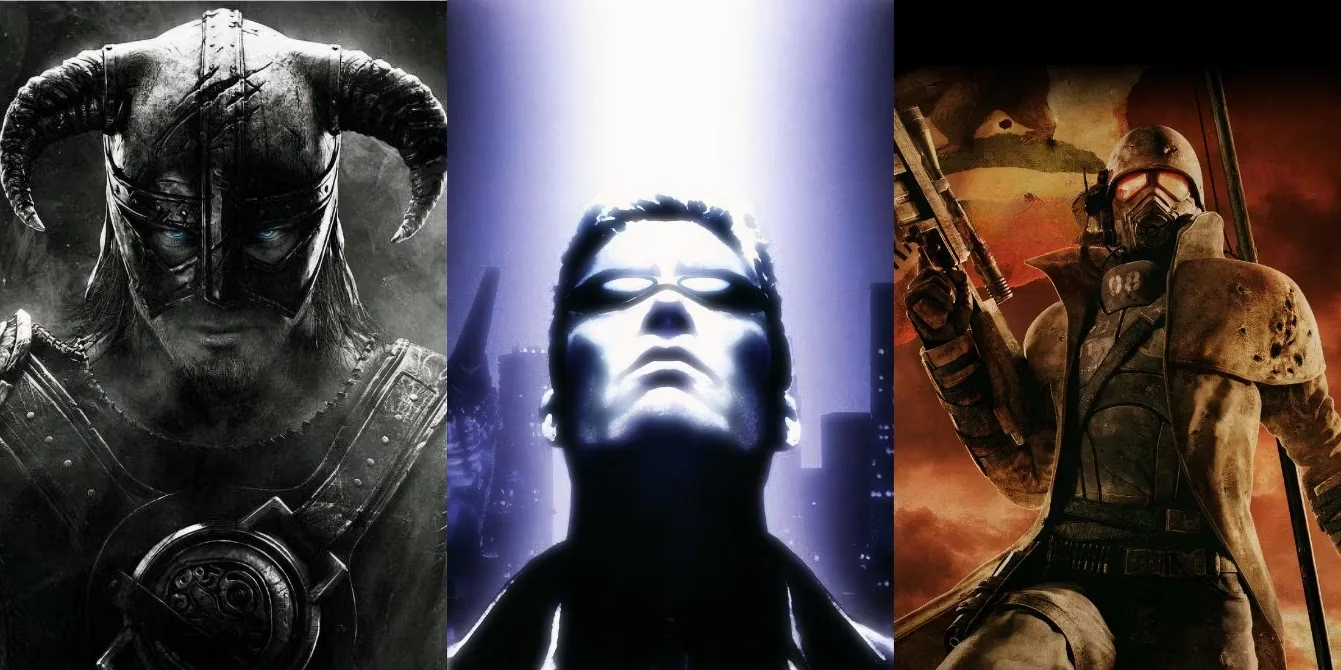
The beauty of Skyrim's system lies in its organic progression. Want to become a master archer? Just use your bow. Interested in destruction magic? Cast fireballs until you're throwing meteors from the heavens. This usage-based advancement created such natural character development that I often found myself accidentally specializing in skills I hadn't planned to pursue. Of course, like many players, I eventually discovered the infamous "stealth archer" optimization—sneaking through dungeons and picking off enemies from the shadows became almost too effective! Still, the sheer accessibility of Skyrim's approach remains unmatched. The game doesn't just allow freedom; it celebrates it by making every action meaningful to your character's growth.
What makes Skyrim's classless design work so well:
-
Organic skill progression through actual use
-
No level caps on individual skills
-
Perk trees that enhance rather than restrict
-
Race-specific bonuses that add flavor without limitation
Kingdom Come: Deliverance 2 - Historical Authenticity Meets Modern Freedom
When I first stepped into the muddy boots of Henry the blacksmith in Kingdom Come: Deliverance 2, I expected historical realism but was pleasantly surprised by the depth of its classless system. The game's commitment to authenticity extends to how Henry develops—there are no magical skill points appearing from nowhere. If you want to become a better swordsman, you need to find someone to train with. Want to improve your reading? Actually sit down with books and struggle through them.
This system creates what I call "emergent specialization." During my playthrough, I found myself naturally gravitating toward a diplomatic approach, improving my speech and charisma through conversations with nobles and commoners alike. The hidden perks system added delightful surprises—after spending hours practicing with a mace, I unlocked a special technique that completely changed how I approached combat. The game rewards dedication to particular skills with meaningful progression that feels earned rather than granted.
Key elements that make this historical RPG's classless system shine:
| Feature | Impact on Gameplay |
|---|---|
| Practice-based progression | Skills only improve through actual use |
| Hidden perks | Unlock special abilities through dedication |
| Combo system | Mastering weapon techniques feels rewarding |
| Realistic limitations | Your background matters but doesn't restrict |
Cyberpunk 2077 - Neon-Laced Flexibility in Night City
Entering the sprawling metropolis of Night City in Cyberpunk 2077, I was initially concerned that the game's adaptation from a class-based tabletop system might lose something in translation. Instead, I discovered one of the most flexible character development systems in modern gaming. As V, I wasn't locked into being a Netrunner, Solo, or Techie—I could blend these archetypes into something uniquely mine.
The attribute and perk system encourages what I like to call "hybrid builds." In my first playthrough, I created a character who could hack security systems with expert precision while still holding her own in firefights. The game's design philosophy seems to be: "Here are tools; build what you need." This approach creates incredible replayability—my second V was a chrome-laced brawler who solved problems with fists and intimidation rather than hacking.
What makes Night City's classless design exceptional:
-
Attribute points that open multiple skill trees simultaneously
-
Cyberware enhancements that complement your chosen path
-
Story flexibility that accommodates different approaches
-
No penalty for mixing combat, stealth, and technical skills
The Witcher 3: Wild Hunt - Defined Character, Flexible Development
Playing as Geralt of Rivia presented an interesting twist on classless design. Here was a character with established lore and abilities, yet The Witcher 3 managed to provide remarkable flexibility within those boundaries. Rather than choosing a class, I was deciding how to specialize this already-capable monster hunter.
The game's three skill trees—Combat, Signs, and Alchemy—initially seemed restrictive compared to other classless systems. However, I quickly discovered the depth possible through mutagen combinations and skill synergies. Building a Geralt who relied heavily on Igni for crowd control while using precise sword strikes felt fundamentally different from creating an alchemy-focused build that enhanced toxicity tolerance for potion abuse.
This approach proves that classless design doesn't require a blank slate protagonist. Even with a defined character like Geralt, players can craft unique versions through:
-
Mutagen combinations that enhance specific playstyles
-
Skill point allocation that emphasizes preferred approaches
-
Gear selection that complements your build
-
Potion and oil preparation that tailors Geralt to specific challenges
FromSoftware's Philosophy: Origins, Not Destinations
My experiences with Bloodborne and Elden Ring taught me that sometimes what looks like class selection is really just a starting suggestion. These games offer what I've come to call "soft origins"—initial stat distributions that gently nudge you toward certain playstyles without ever closing doors.
In Bloodborne, choosing the "Military Veteran" origin gave me a slight strength advantage early on, but nothing prevented me from developing into an arcane powerhouse later. The game's blood echo system meant I could invest in whatever attributes supported my evolving playstyle. This created incredible moments of discovery—realizing I could transform my brute-force hunter into a mystical spellcaster mid-game felt revolutionary.
Elden Ring took this further with its respec system. After defeating Rennala, Queen of the Full Moon, I could completely rebuild my character for relatively few Larval Tears. This meant I could experiment wildly: one week as a lightning-spewing faith build, the next as a stealthy assassin using sleep arrows. The game's community reflects this flexibility—entire online communities dedicated to sharing unique builds prove how much freedom players truly have.
Deus Ex: The Immersive Sim Pioneer
Returning to the classic Deus Ex in recent years, I'm struck by how forward-thinking its classless design was. Playing as JC Denton, every player creates a different version of the nano-augmented agent. Some focus on social engineering, talking their way through obstacles. Others become ghost-like infiltrators who bypass security entirely. My JC became a hybrid—competent in hacking and combat but master of neither.
What makes Deus Ex's system brilliant is its implicit understanding of limitation as a form of characterization. By making it impossible to max out all skills, the game forces meaningful choices. Investing heavily in electronics means less available for weapons training. This creates organic specialization—your JC Denton becomes defined not by a class selected at creation, but by the cumulative choices made throughout the game.
Fallout: New Vegas - The SPECIAL Way
Fallout: New Vegas represents what I consider the pinnacle of classless design in narrative-driven RPGs. The game's SPECIAL system (Strength, Perception, Endurance, Charisma, Intelligence, Agility, Luck) provides a framework so flexible that I've completed the game multiple times with radically different characters:
-
🤠 The Silver-Tongued Gambler: High Charisma and Luck, solving problems through persuasion and fortunate "accidents"
-
🔫 The Veteran Ranger: Combat-focused with high Perception and Agility, specializing in rifles and survival
-
🔧 The Mad Scientist: Intelligence and Repair-focused, using technology to bypass obstacles
-
👻 The Ghost of the Mojave: Sneak and Lockpick specialist who avoids direct conflict entirely
The game's famous flexibility—including the ability to talk your way out of the final confrontation—demonstrates how classless design empowers player agency. Your Courier becomes whoever you make them through skill choices, perk selection, and attribute allocation.
The Future of Classless Design in 2026 and Beyond
Looking at the current RPG landscape in 2026, I see classless design continuing to evolve in exciting directions. Recent games are experimenting with:
✨ Adaptive systems that respond to player behavior patterns
✨ AI-driven skill suggestions based on playstyle without forcing choices
✨ Dynamic difficulty that scales with player specialization
✨ Cross-skill synergies that reward creative combinations
As someone who's played RPGs for decades, I believe the shift toward classless design represents one of the most positive developments in gaming. It respects player intelligence, accommodates diverse playstyles, and creates more personalized stories. Whether I'm exploring the Commonwealth in Fallout 4 with my custom-built survivor or navigating the political intrigue of the latest Baldur's Gate installment with a character who defies traditional categorization, the freedom to create rather than select remains gaming's greatest gift.
The beauty of modern classless RPGs isn't just in their mechanical flexibility, but in how they transform gameplay into self-expression. Each character I create becomes a reflection of my current interests and playstyle preferences. Sometimes I want to be a diplomatic problem-solver; other times, a brute-force warrior. Classless systems accommodate all these versions of myself without judgment or restriction, making each playthrough uniquely mine. In a world increasingly filled with predetermined experiences, these games remind me that creativity and choice still matter—both in gaming and beyond. 🗡️📖✨